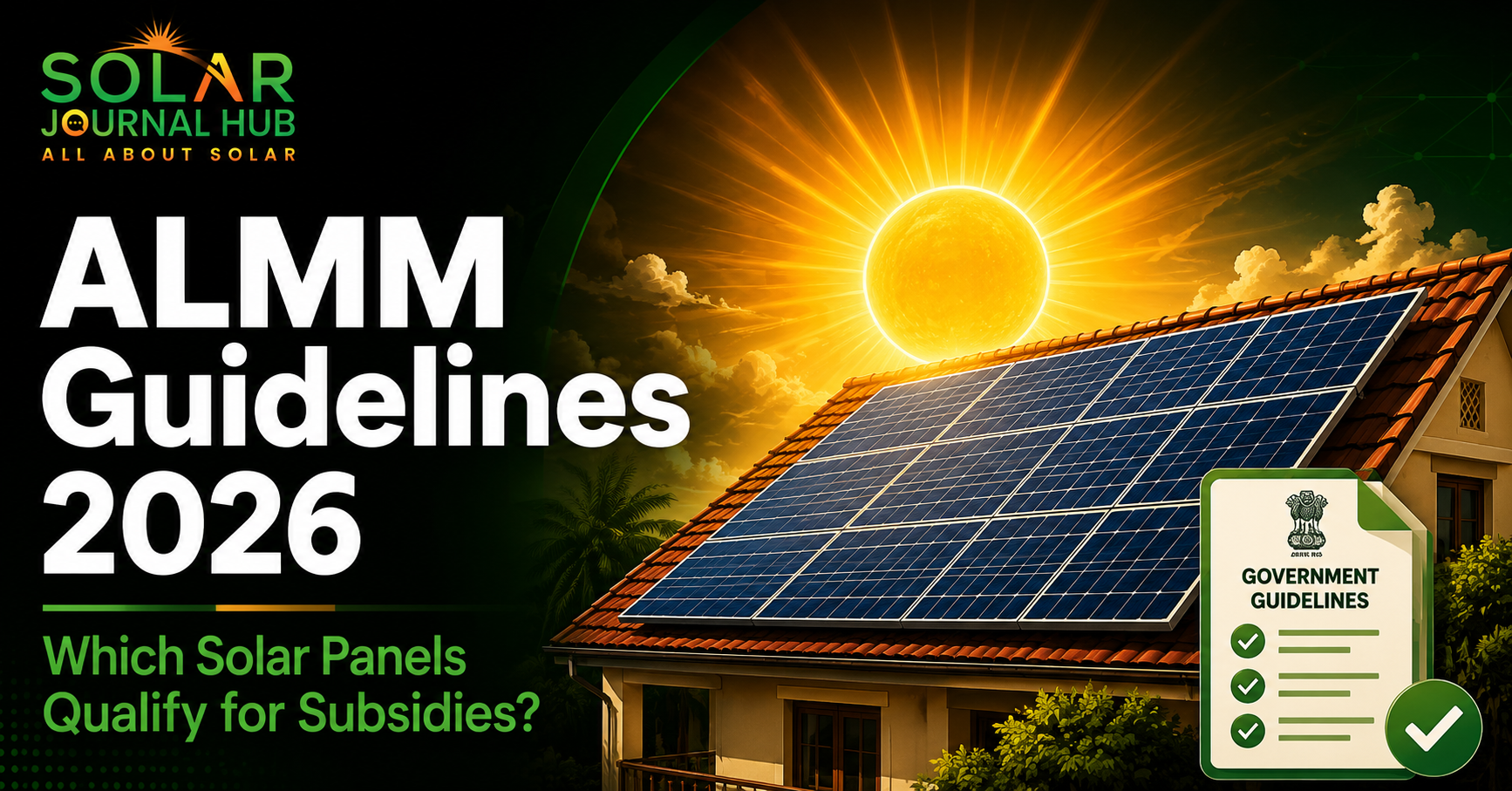
If you are planning a rooftop solar installation in India right now, one three-letter acronym matters more than almost anything else on your quotation sheet: ALMM. From June 1, 2026, the rules around which solar panels qualify for government subsidies and net-metering tightened significantly, and a panel that looked compliant in April may no longer be compliant in July.
This matters whether you are a homeowner applying under PM Surya Ghar, a business planning a commercial rooftop project, or simply trying to understand why your installer suddenly wants to change your quoted panel brand. Here is what actually changed, and how to check compliance before you sign anything.
What Is the ALMM List, and Why Did It Just Get Stricter
The Approved List of Models and Manufacturers, maintained by the Ministry of New and Renewable Energy, has existed since 2019 as a quality gate for solar panels used in government and subsidy-linked projects. It works in two parts, and understanding the difference between them is the key to this whole update.
List-I covers finished solar panels, the modules themselves. If a panel model is not on this list, it cannot be used in government projects, subsidy-backed installations, open-access projects, or net-metering connections.
List-II is newer and covers the solar cells that go inside those panels. Before June 2026, a manufacturer could build an ALMM-listed panel using imported cells, largely from China. That is no longer allowed.
The June 1, 2026 Change, Explained Simply
From June 1, 2026, every solar panel used in a subsidy-linked or government project must not only appear on List-I, it must also be built using cells sourced from a List-II approved domestic manufacturer. In other words, both the panel and what is inside the panel now need separate approval.
This is essentially a domestic content requirement, aimed at reducing India’s dependence on imported solar cells and strengthening domestic cell manufacturing. By the time the mandate took effect, MNRE considered domestic cell capacity, roughly 30 GW under List-II, sufficient to support the transition.
MNRE has been firm that there will be no blanket extension of this deadline. However, it has allowed limited, case-by-case relief for projects that were substantially complete before June 1, such as installations where modules had already reached the site or where 50 percent or more of the panels were physically installed, backed by geo-tagged photographs and invoices. Applications for this relief had to be submitted through the National Institute of Solar Energy portal.
How to Check If Your Solar Panel Actually Qualifies
This is the part installers sometimes gloss over, and it is worth doing yourself rather than taking a vendor’s word for it.
Check the model, not just the brand. A manufacturer might have dozens of panel models, but only some of them will be current on the ALMM list. A brand name alone tells you nothing about a specific model’s status.
Cross-reference the official MNRE list. The updated List-I for solar PV modules is published and revised regularly on mnre.gov.in. Always check the latest revision date against your quotation date.
Confirm BIS registration is valid. A module is only genuinely ALMM-compliant if its Bureau of Indian Standards registration is current, not expired or under review.
Ask specifically about cell sourcing. For any project commissioning after June 1, 2026, ask your installer in writing to confirm the panel’s cells come from a List-II approved domestic manufacturer, not just that the panel model itself is listed.
Get documentation, not just assurances. Request the model number, BIS certificate, and cell sourcing declaration in writing before final payment, particularly for subsidy-linked installations.
If an installer cannot answer these questions clearly, that is a signal to pause and verify independently before proceeding.
Tracking Your PM Surya Ghar Application and Subsidy Status
ALMM compliance is only half the picture for residential rooftop buyers. The PM Surya Ghar: Muft Bijli Yojana subsidy, worth up to Rs 78,000 depending on system size, is only released after several stages are completed and verified, and every stage is trackable on the national portal at pmsuryaghar.gov.in.
The typical application journey moves through:
Registration and feasibility approval, tied to your electricity consumer number and DISCOM
Vendor selection and installation, using ALMM List-I and, since June 2026, List-II compliant equipment
Net-metering application, filed through your DISCOM
Inspection and commissioning, confirming the system meets technical and compliance standards
Subsidy disbursal, credited directly to the applicant’s bank account
You can log in with your registered mobile number to see live progress on each stage. If your feasibility approval is stuck, check your dashboard for a pending DISCOM query, since a sanctioned load enhancement is often the hidden blocker. If a vendor is unresponsive, the portal lets you choose from any registered vendor in your area rather than waiting indefinitely on one.
One point worth remembering: the subsidy is disbursed after the system is commissioned, not before. The full installation cost has to be arranged upfront, which is where financing becomes relevant.
World Bank-Backed Financing for Rooftop Solar
In July 2026, the World Bank’s Board of Executive Directors approved an USD 890 million financing package to accelerate India’s rooftop solar program, structured as an USD 820 million loan from the International Bank for Reconstruction and Development, a USD 60 million concessional loan from the Clean Technology Fund, and a USD 10 million grant from IBRD’s Livable Planet Fund. Alongside this, the World Bank plans to mobilise an additional USD 4.2 billion in private commercial financing to support household solar installations.
This builds on more than a decade of World Bank support for India’s rooftop solar sector, which has already helped grow installed capacity from 500 MW to over 27 GW. Practically, this translates into more accessible collateral-free financing routed through banks and NBFCs.
For homeowners, the financing landscape currently includes two broad paths:
PSU bank loans, such as those from SBI and PNB, offering interest rates from around 5.75 percent per annum for loans up to Rs 2 lakh, though opting for this route typically means surrendering the direct subsidy in favour of the reduced rate
NBFC financing, offering faster digital approval and letting you retain the government subsidy, though usually at a noticeably higher interest rate
Which option makes sense depends on whether you value a lower interest rate or faster access to funds while keeping your subsidy intact. It is worth comparing both before committing.
Frequently Asked Questions
Is ALMM compliance mandatory for private commercial and industrial projects?
The mandate primarily targets government-funded and subsidy-linked projects, but many banks and DISCOMs now require ALMM compliance as a condition for project financing and net-metering approval even in private commercial projects.
What happens if a panel model is removed from the ALMM list after I have already purchased it?
If the panel was listed at the time of procurement and you retain the invoice as proof, the installation is generally considered safe, though it is wise to confirm this with your DISCOM before commissioning.
Can I still get a rooftop subsidy if my installer used non-ALMM panels?
No. Using non-compliant panels or an unregistered installer can result in forfeiture of the PM Surya Ghar subsidy, regardless of how far along the installation is.
Do I need a loan even after getting the subsidy?
Yes, in most cases. The subsidy is credited only after the system is commissioned and verified, so the full upfront installation cost needs to be financed first, through savings, a bank loan, or NBFC financing.
The Bottom Line
The June 2026 ALMM tightening is not just paperwork. It directly determines whether your rooftop project qualifies for the subsidy you are counting on, and skipping the verification step can mean losing that subsidy entirely after the system is already installed. Before signing off on any solar quotation this year, check the model against the current MNRE list, confirm the cell sourcing in writing, and track your PM Surya Ghar application status regularly rather than assuming it is moving on its own.
Yushmita
Solar Blogs
Navigating the June 2026 ALMM Guidelines: Which Solar Panels Qualify for Subsidies?
If you are planning a rooftop solar installation in India right now, one three-letter acronym matters more than almost anything else on your quotation sheet: ALMM. From June 1, 2026, the rules around which solar panels qualify for government subsidies and net-metering tightened significantly, and a panel that looked compliant in April may no longer be compliant in July.
This matters whether you are a homeowner applying under PM Surya Ghar, a business planning a commercial rooftop project, or simply trying to understand why your installer suddenly wants to change your quoted panel brand. Here is what actually changed, and how to check compliance before you sign anything.
What Is the ALMM List, and Why Did It Just Get Stricter
The Approved List of Models and Manufacturers, maintained by the Ministry of New and Renewable Energy, has existed since 2019 as a quality gate for solar panels used in government and subsidy-linked projects. It works in two parts, and understanding the difference between them is the key to this whole update.
List-I covers finished solar panels, the modules themselves. If a panel model is not on this list, it cannot be used in government projects, subsidy-backed installations, open-access projects, or net-metering connections.
List-II is newer and covers the solar cells that go inside those panels. Before June 2026, a manufacturer could build an ALMM-listed panel using imported cells, largely from China. That is no longer allowed.
The June 1, 2026 Change, Explained Simply
From June 1, 2026, every solar panel used in a subsidy-linked or government project must not only appear on List-I, it must also be built using cells sourced from a List-II approved domestic manufacturer. In other words, both the panel and what is inside the panel now need separate approval.
This is essentially a domestic content requirement, aimed at reducing India’s dependence on imported solar cells and strengthening domestic cell manufacturing. By the time the mandate took effect, MNRE considered domestic cell capacity, roughly 30 GW under List-II, sufficient to support the transition.
MNRE has been firm that there will be no blanket extension of this deadline. However, it has allowed limited, case-by-case relief for projects that were substantially complete before June 1, such as installations where modules had already reached the site or where 50 percent or more of the panels were physically installed, backed by geo-tagged photographs and invoices. Applications for this relief had to be submitted through the National Institute of Solar Energy portal.
How to Check If Your Solar Panel Actually Qualifies
This is the part installers sometimes gloss over, and it is worth doing yourself rather than taking a vendor’s word for it.
Check the model, not just the brand. A manufacturer might have dozens of panel models, but only some of them will be current on the ALMM list. A brand name alone tells you nothing about a specific model’s status.
Cross-reference the official MNRE list. The updated List-I for solar PV modules is published and revised regularly on mnre.gov.in. Always check the latest revision date against your quotation date.
Confirm BIS registration is valid. A module is only genuinely ALMM-compliant if its Bureau of Indian Standards registration is current, not expired or under review.
Ask specifically about cell sourcing. For any project commissioning after June 1, 2026, ask your installer in writing to confirm the panel’s cells come from a List-II approved domestic manufacturer, not just that the panel model itself is listed.
Get documentation, not just assurances. Request the model number, BIS certificate, and cell sourcing declaration in writing before final payment, particularly for subsidy-linked installations.
If an installer cannot answer these questions clearly, that is a signal to pause and verify independently before proceeding.
Tracking Your PM Surya Ghar Application and Subsidy Status
ALMM compliance is only half the picture for residential rooftop buyers. The PM Surya Ghar: Muft Bijli Yojana subsidy, worth up to Rs 78,000 depending on system size, is only released after several stages are completed and verified, and every stage is trackable on the national portal at pmsuryaghar.gov.in.
The typical application journey moves through:
Registration and feasibility approval, tied to your electricity consumer number and DISCOM
Vendor selection and installation, using ALMM List-I and, since June 2026, List-II compliant equipment
Net-metering application, filed through your DISCOM
Inspection and commissioning, confirming the system meets technical and compliance standards
Subsidy disbursal, credited directly to the applicant’s bank account
You can log in with your registered mobile number to see live progress on each stage. If your feasibility approval is stuck, check your dashboard for a pending DISCOM query, since a sanctioned load enhancement is often the hidden blocker. If a vendor is unresponsive, the portal lets you choose from any registered vendor in your area rather than waiting indefinitely on one.
One point worth remembering: the subsidy is disbursed after the system is commissioned, not before. The full installation cost has to be arranged upfront, which is where financing becomes relevant.
World Bank-Backed Financing for Rooftop Solar
In July 2026, the World Bank’s Board of Executive Directors approved an USD 890 million financing package to accelerate India’s rooftop solar program, structured as an USD 820 million loan from the International Bank for Reconstruction and Development, a USD 60 million concessional loan from the Clean Technology Fund, and a USD 10 million grant from IBRD’s Livable Planet Fund. Alongside this, the World Bank plans to mobilise an additional USD 4.2 billion in private commercial financing to support household solar installations.
This builds on more than a decade of World Bank support for India’s rooftop solar sector, which has already helped grow installed capacity from 500 MW to over 27 GW. Practically, this translates into more accessible collateral-free financing routed through banks and NBFCs.
For homeowners, the financing landscape currently includes two broad paths:
PSU bank loans, such as those from SBI and PNB, offering interest rates from around 5.75 percent per annum for loans up to Rs 2 lakh, though opting for this route typically means surrendering the direct subsidy in favour of the reduced rate
NBFC financing, offering faster digital approval and letting you retain the government subsidy, though usually at a noticeably higher interest rate
Which option makes sense depends on whether you value a lower interest rate or faster access to funds while keeping your subsidy intact. It is worth comparing both before committing.
Frequently Asked Questions
Is ALMM compliance mandatory for private commercial and industrial projects?
The mandate primarily targets government-funded and subsidy-linked projects, but many banks and DISCOMs now require ALMM compliance as a condition for project financing and net-metering approval even in private commercial projects.
What happens if a panel model is removed from the ALMM list after I have already purchased it?
If the panel was listed at the time of procurement and you retain the invoice as proof, the installation is generally considered safe, though it is wise to confirm this with your DISCOM before commissioning.
Can I still get a rooftop subsidy if my installer used non-ALMM panels?
No. Using non-compliant panels or an unregistered installer can result in forfeiture of the PM Surya Ghar subsidy, regardless of how far along the installation is.
Do I need a loan even after getting the subsidy?
Yes, in most cases. The subsidy is credited only after the system is commissioned and verified, so the full upfront installation cost needs to be financed first, through savings, a bank loan, or NBFC financing.
The Bottom Line
The June 2026 ALMM tightening is not just paperwork. It directly determines whether your rooftop project qualifies for the subsidy you are counting on, and skipping the verification step can mean losing that subsidy entirely after the system is already installed. Before signing off on any solar quotation this year, check the model against the current MNRE list, confirm the cell sourcing in writing, and track your PM Surya Ghar application status regularly rather than assuming it is moving on its own.
At Solar Journal Hub, is to empower you with the knowledge to choose the ideal solar solution for your requirements. Let’s embark on your journey to a brighter, more sustainable future!